
Complete guide to 0 euro souvenir banknotes
Updated on 16 October 2026
Souvenir banknotes, also known as tourist banknotes or 0€ banknotes, have become a genuine collecting phenomenon across Europe in just a few years. Sold at monuments, museums and tourist sites, they appeal to visitors and collectors alike thanks to their print quality and the sheer number of designs.
Here is everything you need to know: their history, how they are made, where to buy them, how to identify them and why some are now worth, as a rough guide, several hundred euros.
The essentials in 30 seconds
- What it is
- A collectible tourist banknote with a face value of zero, also called a Euro Souvenir banknote, 0€ banknote or zero euro banknote. It is not legal tender and cannot be used to pay.
- Format and printing
- 133 × 72 mm, close to a 20 € note, printed on banknote paper by Oberthur with a watermark, hologram, security thread and UV inks.
- Since when
- Created by Richard Faille and launched on 1 April 2015 in France, then in more than 30 countries.
- Purchase price
- Usually 2 to 3 € at the tourist site (up to 10 € in some countries).
- Collector value
- From its original price to several hundred euros for rare editions (first editions, small print runs, misprints), as an indication.
- Where to find them
- Museum and monument shops, tourist offices, vending machines, and some editions online: see the map of sales points.
What is a 0 euro souvenir banknote?
The 0 euro souvenir banknote, also called a tourist banknote or Euro Souvenir banknote, is a collectible banknote created in 2015 by Richard Faille, who was already behind the famous tourist medals of the Monnaie de Paris.
The principle is simple: any monument, museum, town or event can have its own personalised banknote.
These banknotes are not a means of payment. They are intended solely as tourist souvenirs and collector's items.
Today, several thousand designs have been issued throughout Europe and beyond. In German they are called "0 Euro Schein", "Null-Euro-Schein" or "Euro Souvenirschein", and in French "billet 0 euro souvenir" or "billet zéro euro".
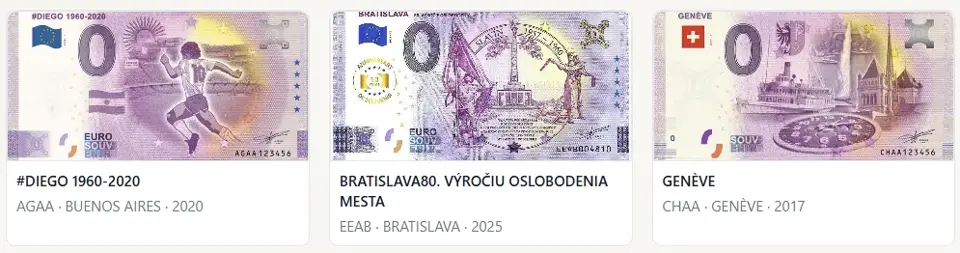
Who makes 0 euro banknotes?
The banknotes are issued by Euro Banknote Memory (EBM) and printed by Oberthur Cash Protection (formerly Oberthur Fiduciaire), one of the leading banknote printers in Europe.
They are produced using processes close to those used for real euro banknotes, so their quality is comparable to that of a genuine banknote.
The history of the 0 euro souvenir banknote and Richard Faille
It all started in 1996, when Richard Faille teamed up with the Monnaie de Paris to create personalised tourist tokens, handed out or sold to visitors by museums, parks and tourist sites. More than 60 million personalised pieces were sold over 18 years of collaboration.
In 2015 he launched a more modern concept to follow the tokens: the tourist banknote, also called the Euro Souvenir banknote or 0€ banknote. The first banknotes were presented to the public on 1 April 2015: about a hundred different designs, all from French sites, sold for 2 € each.
Success was immediate and the concept spread: Germany, Austria, Spain, Portugal, Belgium, Luxembourg and Switzerland, then Slovakia and the Czech Republic in 2018, and Poland in 2019. It even crossed the borders of the European Union, with banknotes issued in the United States, Russia, China, Turkey and Sweden. By 2021, more than 2,500 different designs existed across 30 countries.
What makes the banknote special is that it can showcase monuments, sites or personalities that appear on no real banknote. For tourist sites, selling them also brings in revenue that helps maintain and enhance their heritage.
Commercially, the craze was such that in several destinations the souvenir banknote has overtaken classic souvenirs. Collectors plan their trips around it, often with their families, to pick up new ones.
What is a banknote made up of?
Every banknote carries several elements that identify it.
These include:
- a 4-letter code identifying the design;
- a unique serial number;
- a millesime giving the year and the edition number.
No two banknotes ever share the same serial number within a given millesime, so every banknote is unique.
Banknotes measure 133 × 72 mm, very close to the format of a 20 € note.
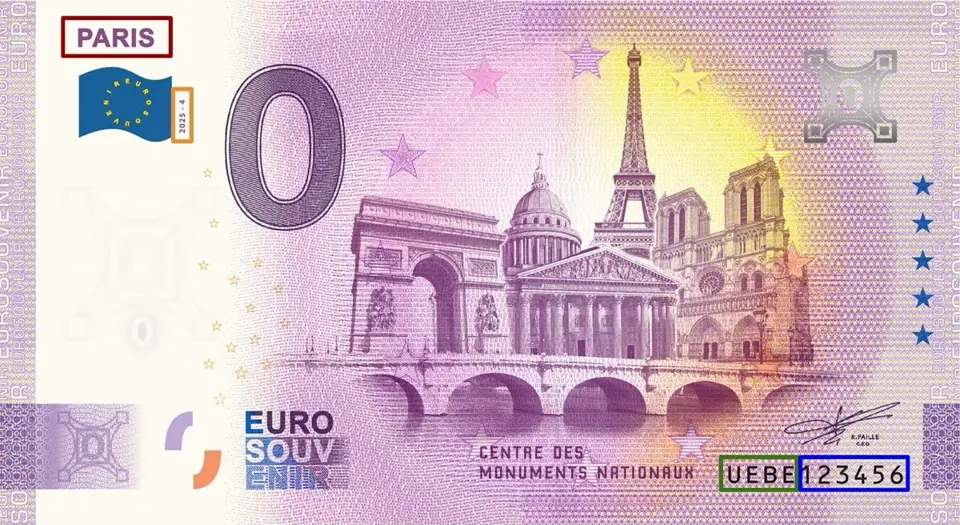
The front
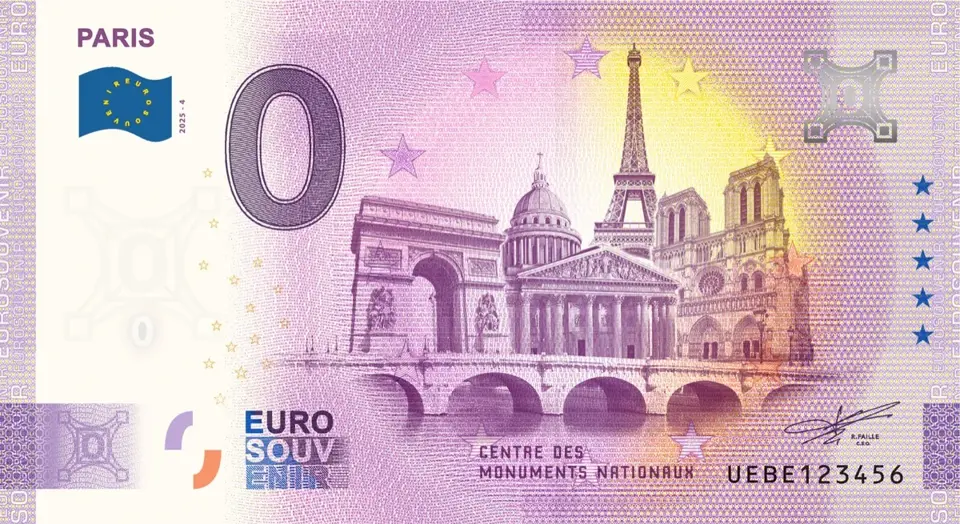
The front is the personalised side of the banknote. It shows the monument, museum, castle, park, figure or event the banknote is dedicated to. This side is specific to each edition and gives the banknote its identity.
It carries:
- the main artwork;
- the four-letter code (for example UEBE);
- the serial number (for example 123456);
- the millesime (for example 2025-4);
- the various security features.
The back
The back is common to all souvenir banknotes.
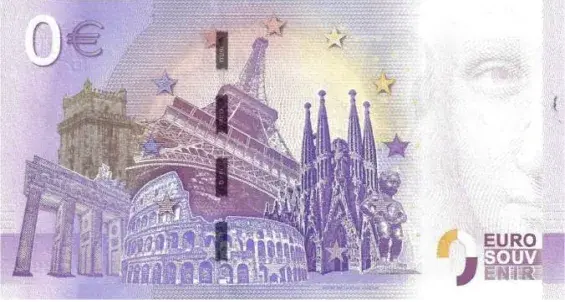
It bears the wording « 0 EURO » along with a composition showing several iconic European monuments.
The design of the back has changed over the years.
The first 2015 editions showed in particular:
- the Eiffel Tower;
- Mont-Saint-Michel;
- the Pont du Gard;
- Notre-Dame de Paris;
- the Mona Lisa.
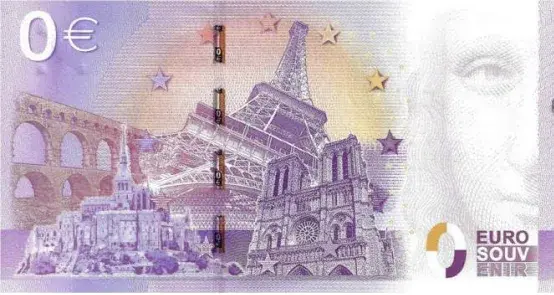
From 2016, new European monuments replaced some of these illustrations, such as the Brandenburg Gate, Big Ben and the Colosseum.
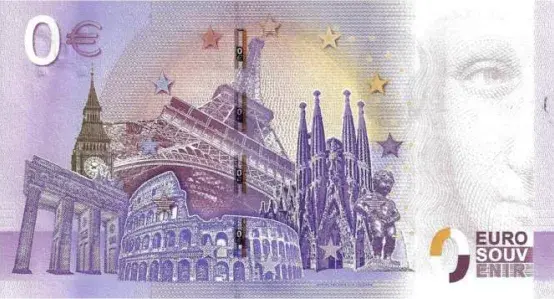
In 2017, Brexit obliged: Big Ben was replaced by the Belém Tower (Lisbon).
Security features
0€ banknotes include many security devices similar to those used on real banknotes.
These include:
- a watermark visible against the light;
- an iridescent hologram;
- an embedded security thread;
- micro-lettering;
- inks visible under ultraviolet (UV) light;
- a see-through register effect;
- high-precision banknote printing.
These devices make the banknotes extremely difficult to counterfeit.
They cannot, of course, be used as a means of payment.
Can a 0€ banknote be mistaken for a real one?
No. A 0€ banknote is not legal tender and differs from a circulating banknote by its colours, by the "0 €", "0 EURO" and "Euro Souvenir" wording, and by its designs. It cannot be slipped into a bundle as is or pass as a means of payment.
Their paper differs slightly from that of real banknotes, which keeps automatic machines from mistaking them for a means of payment. The publisher has also released tests carried out with a counterfeit banknote detector: circulating banknotes are recognised as valid, while the souvenir banknote is systematically detected.
Among the security features built into its production, some elements react to ultraviolet light, protecting collectors from forgeries and duplicates.
Where can you buy a 0 euro banknote?
Souvenir banknotes are mainly sold directly at tourist sites.
You will find them in particular:
- in museum shops;
- in souvenir shops;
- in tourist offices;
- at monument ticket desks;
- in some vending machines.
Some editions are also sold exclusively online.
Our site lets you find every point of sale easily on our interactive map, or browse every listed banknote in our catalogue.
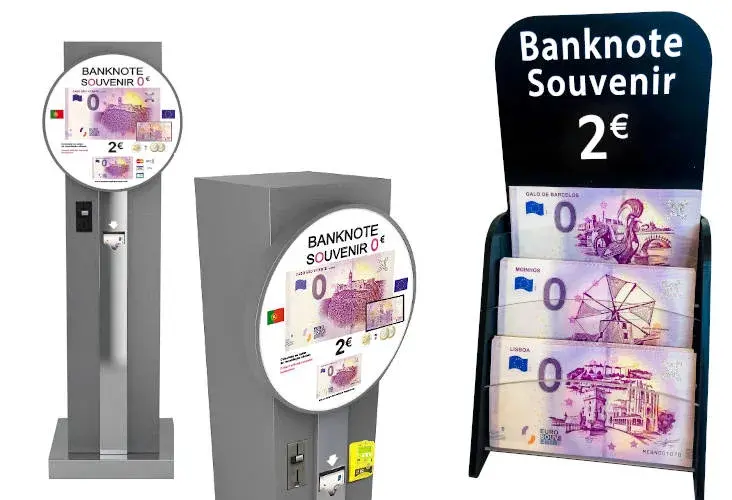
How to find a souvenir banknote near you?
To find a souvenir or tourist banknote, the easiest way is to start from a place: each museum, monument, park or city that issues its own banknote sells it on site. Our souvenir banknote map lists these sales points, including those that no longer sell them.
Looking to buy souvenir banknotes without travelling? Some editions are also offered online by listed shops.
How much does a 0 euro banknote cost?
At launch, banknotes usually sell for between 2 € and 3 €, depending on the tourist site. In some countries, however, souvenir banknotes can go beyond 10 € (Poland, for example).
Their value can then change according to several criteria:
- rarity;
- the print run;
- the millesime;
- the serial number;
- the state of preservation;
- collector demand.
Some banknotes are worth only their original price, while others reach, as a rough guide, several hundred euros on the collectors' market.
Why are some banknotes rare?
Not every banknote is of equal interest to collectors.
The most sought-after are usually:
- the first editions (2015);
- small print runs;
- low serial numbers;
- banknotes quickly withdrawn from sale;
- printing errors.
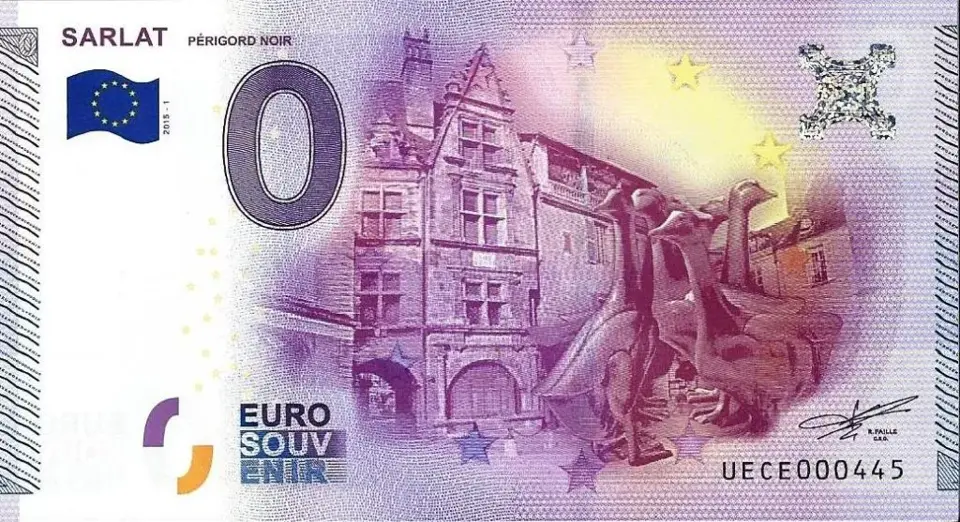
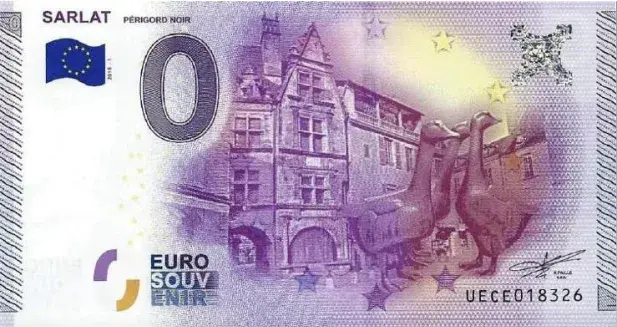
One of the best-known examples is the Sarlat-la-Canéda banknote, whose first version showed six geese instead of three. The error was corrected quickly, and the affected copies are now highly sought after.
Collecting 0 euro banknotes
Collecting 0€ banknotes has become a passion for thousands of people.
Some collect only the banknotes of their own region, while others try to gather every French or European edition.
Others look for:
- low serial numbers;
- commemorative banknotes;
- limited editions;
- millesime variants;
- printing errors.
Banknotes are generally delivered to points of sale in bundles of 100 with continuous numbering, which explains the particular interest in low serial numbers.
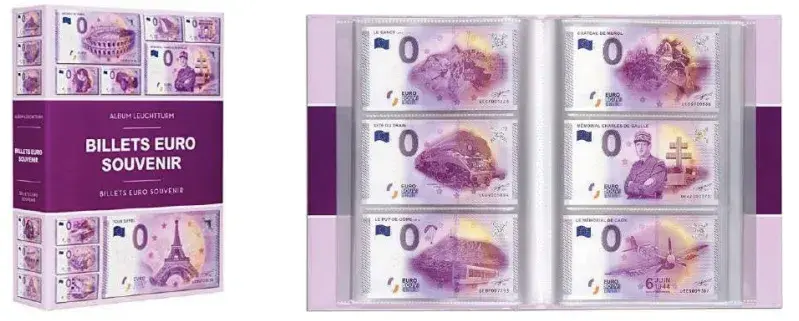
To meet collectors' needs, storage albums dedicated to souvenir banknotes have been created.
Our site also lets you organise your banknotes virtually so you can take them everywhere with you, even when travelling!
What is a 0 euro banknote worth?
Even though they sell for between 2 € and 3 €, some banknotes reach far higher prices on the collectors' market.
A few famous examples (observed prices, for information only):
- Sarlat-la-Canéda « 6 geese »: several hundred euros, for information only;
- Arc de Triomphe (first editions): around 180 to 200 €;
- MSV Duisburg (Germany): sold for close to 1,000 € in a private sale.
Value depends mainly on rarity, the print run, the condition of the banknote, the millesime, the serial number and demand.
Identifying a banknote's country
Every souvenir banknote carries a four-character code printed on the front (for example UEBE, XABC, and so on).
The first letter of that code identifies the issuing country, following the nomenclature used by Euro Banknote Memory.
Here are the main country codes in use:
| Code | Country |
|---|---|
| U | France |
| X | Germany |
| V | Spain |
| S | Italy |
| M | Portugal |
| B | Belgium |
| N | Netherlands |
| L | Luxembourg |
| T | Austria |
| G | Greece |
| F | Finland |
| E | Slovenia |
| H | Hungary |
| P | Poland |
| C | Czech Republic |
| D | Croatia |
| K | Switzerland |
The next three letters then identify the exact model of the banknote (the monument, tourist site or design concerned).
For example:
UEBE 123456
- U → France
- EBE → design reference
- 123456 → the banknote's unique serial number
This coding lets collectors quickly identify where a banknote comes from and sort their collections by country.
Frequently asked questions about souvenir banknotes
Does a 0 euro souvenir banknote have any value?
No monetary value: it cannot be used to pay. Its collector value ranges from the purchase price (2 to 3 €) to several hundred euros for rare editions.
Where can I buy a souvenir banknote?
On site, in the shop of the museum, monument or tourist office that issues it, sometimes from a vending machine, and online for some editions. Our map lists the sales points.
How do I recognise a genuine 0 euro banknote?
By its security features (watermark, hologram, security thread, UV inks), its four-letter code, its serial number and its year printed on the front.
How many souvenir banknotes exist?
Several thousand designs since 2015, in more than 30 countries. Our catalogue lists more than 5,000 of them, with images and sales points.
Put it into practice
Note the banknotes you own, follow your progress and earn badges. The account is free.
Explore 0 euro notes by country and by year
0 euro notes by country
- 0 euro notes France (1,617)
- 0 euro notes Germany (1,612)
- 0 euro notes Slovakia (408)
- 0 euro notes Portugal (211)
- 0 euro notes Spain (201)
- 0 euro notes Italy (201)
- 0 euro notes Netherlands (145)
- 0 euro notes Austria (130)
- 0 euro notes Finland (113)
- 0 euro notes Belgium (109)
- 0 euro notes Switzerland (107)
- 0 euro notes Poland (96)
0 euro notes by year
- 0 euro notes 2026 (445)
- 0 euro notes 2025 (706)
- 0 euro notes 2024 (571)
- 0 euro notes 2023 (523)
- 0 euro notes 2022 (645)
- 0 euro notes 2021 (572)
- 0 euro notes 2020 (434)
- 0 euro notes 2019 (622)
- 0 euro notes 2018 (523)
- 0 euro notes 2017 (268)
- 0 euro notes 2016 (125)
- 0 euro notes 2015 (95)
All countries · All years · Full catalogue · Where to buy a 0 euro note